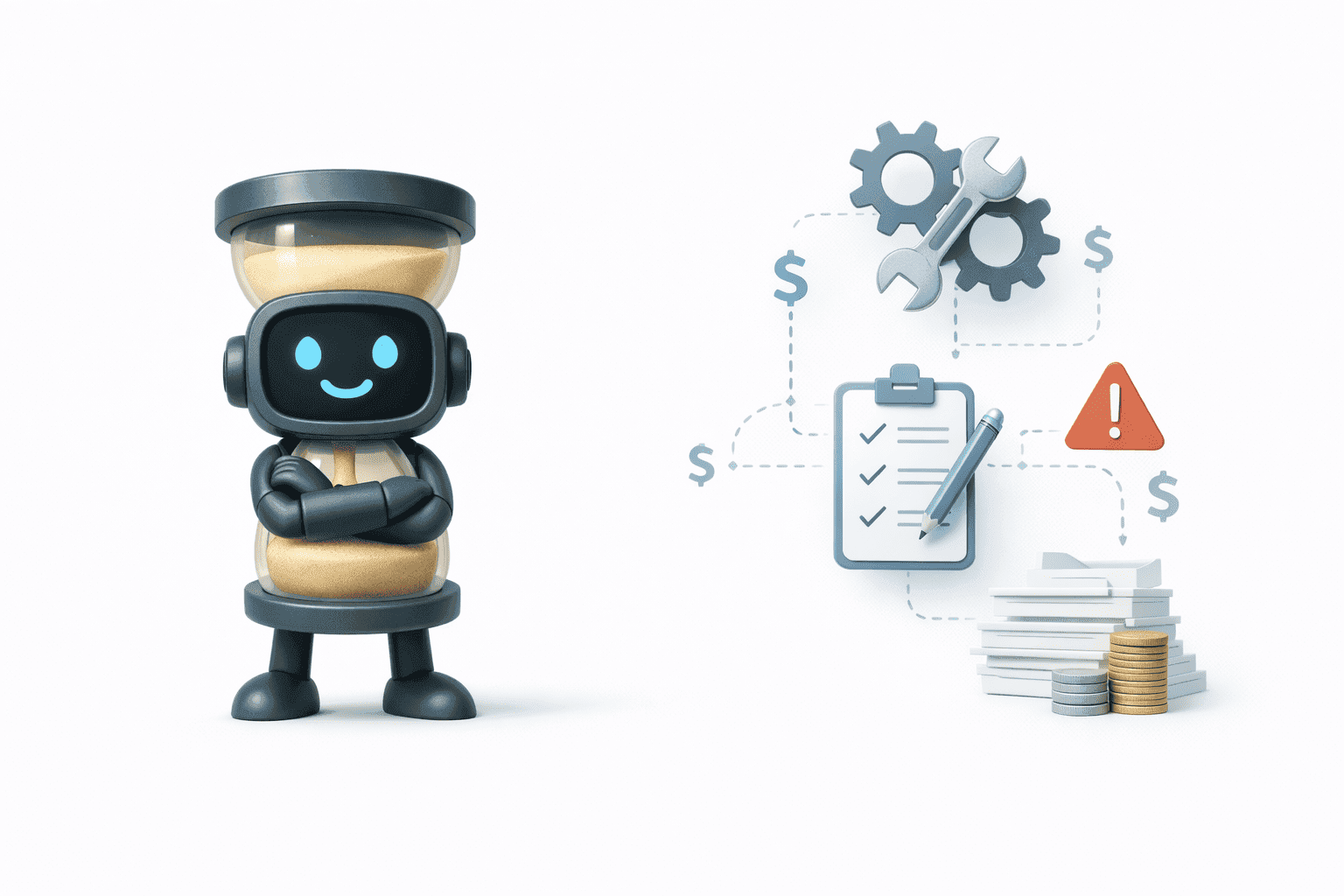
The Real Cost of AI Automation Shows Up in Your Operations, Not Your Tech Stack
Most discussions around AI automation still focus on tools. Which platform to use, which model performs better, which integrations are available. It sounds logical. Technology is visible. It’s easy to compare.
But once automation is actually running inside a business, the costs don’t show up in the tools. They show up in how the business operates around them.
You see it in delays that shouldn’t exist, in teams double-checking outputs, in workflows that technically run but don’t move anything forward. That’s where automation starts getting expensive, even if the software itself isn’t.
AI automation and business consulting at K.B Consultancy: where operational costs quietly build up
The first version of an automated workflow often looks fine. It runs, it produces output, maybe even saves time in a controlled setting. The problem starts when that same workflow becomes part of daily operations.
That’s when the hidden costs begin to surface.
Not as invoices, but as friction:
• Teams correcting automated outputs
• Managers stepping in to validate decisions
• Data being re-entered because something didn’t sync properly
• Exceptions handled manually outside the system
None of this shows up in a tech stack comparison. But it directly impacts how much value the automation is actually delivering.
At K.B Consultancy, this is usually where projects get re-evaluated. Not because the automation failed, but because the operational cost of keeping it running starts to outweigh the benefits. And that almost always traces back to how the process was structured before automation was introduced.
Business process automation and software development: when systems shift work instead of removing it
A common misconception is that automation removes work. In reality, poorly designed automation just moves work somewhere else.
Instead of doing a task manually from start to finish, teams now:
• monitor the system
• fix edge cases
• handle exceptions the workflow can’t process
• interpret outputs that aren’t fully reliable
The work didn’t disappear. It changed shape.
This is where software development and automation decisions start to matter more. Not in terms of features, but in how well systems reflect real operational behavior.
If a system assumes clean, structured input but the business operates with messy, incomplete data, the gap has to be filled somewhere. Usually by people.
That’s the hidden cost. Not the automation itself, but the human effort required to keep it usable.
Good systems reduce decision-making overhead. Bad systems redistribute it.
AI automation cost isn’t technical, it’s operational
There’s a shift happening across companies adopting AI. Early on, the focus was on capability. What can we automate? What can AI do for us?
Now the question is different. Does it hold up in daily use?
This is where things start breaking.
You begin to notice that:
• workflows only work under ideal conditions
• dashboards don’t match what teams are seeing on the ground
• automation outputs require interpretation instead of action
At that point, trust drops. And once trust drops, usage follows.
That’s where the real cost becomes visible. Not in licensing fees, but in lost momentum. Teams slow down because they don’t fully rely on the system. Decisions take longer because outputs need validation. Growth becomes harder to sustain because operations aren’t predictable.
None of that shows up in a tool comparison.
Building AI automation systems that reduce operational cost instead of increasing it
When automation actually delivers value, it doesn’t just run. It fits.
Processes are clear enough that automation doesn’t need constant correction. Systems reflect how work is actually done, not how it was designed in theory. Data flows in a way that supports decisions, not just reporting.
That alignment is what removes operational cost.
At K.B Consultancy, this is the difference between automation that looks good and automation that holds. The focus is rarely on adding more tooling. It’s on tightening the structure underneath:
• defining how work actually moves
• aligning systems with real decision points
• reducing ambiguity in data and inputs
Once that is in place, automation starts doing what companies expect it to do from the beginning. Not just speed things up, but remove the need for constant intervention.
Where to look if your AI automation feels expensive
If automation feels heavier than expected, the issue is rarely the tool itself.
Look at the surrounding behavior.
Where are teams stepping in to correct outputs?
Where does manual work still exist next to automation?
Where do processes rely on assumptions that don’t hold in practice?
Those are the points where operational cost builds up.
Fixing them usually doesn’t require new technology. It requires a clearer structure.
Once that’s in place, the cost of automation drops naturally. Not because you’re paying less for tools, but because the business no longer has to compensate for them.
1 April 2026