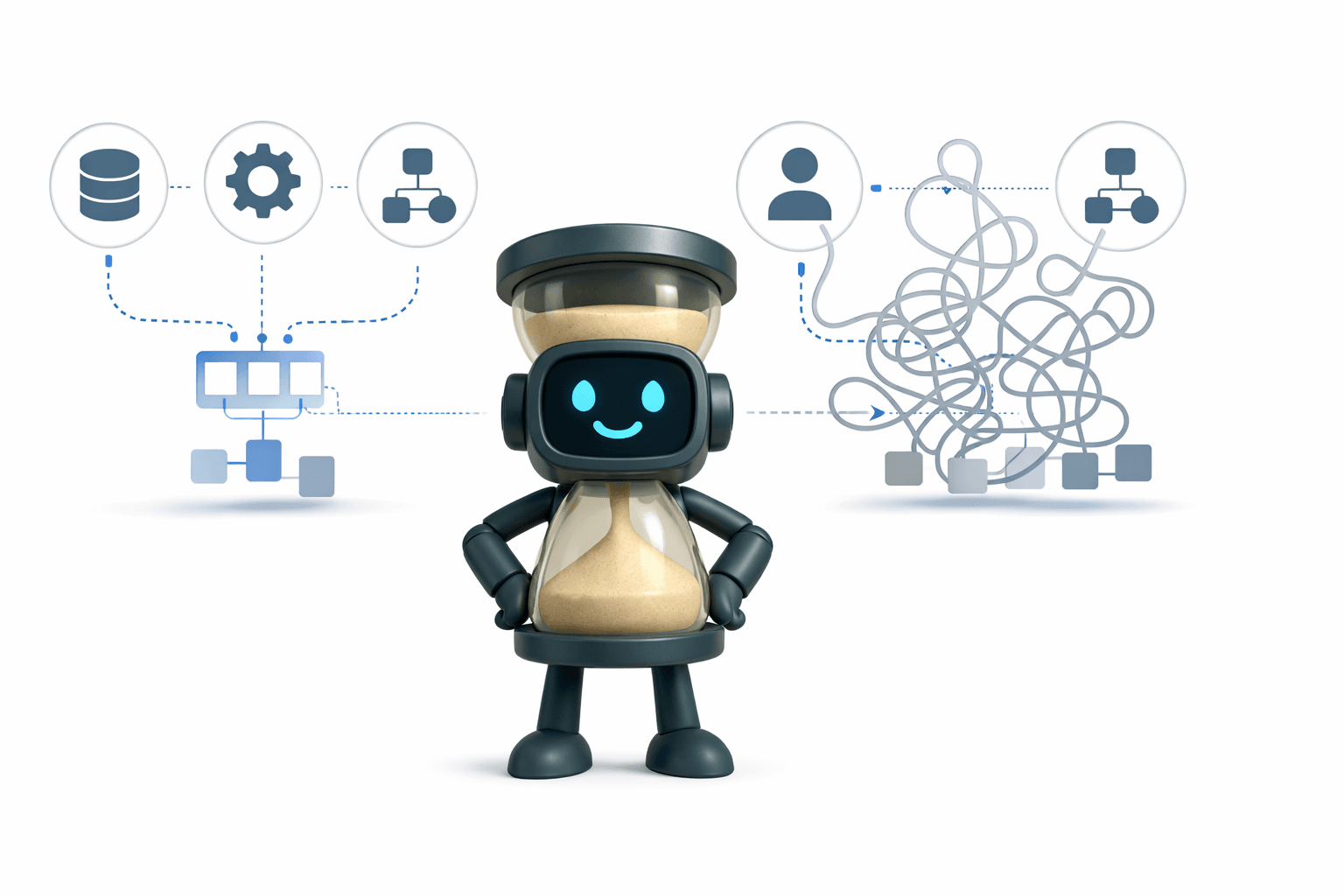
Most AI Workflows Look Efficient Until You See How Teams Actually Use Them
On paper, most AI workflows look sharp. Clean diagrams, clear steps, everything connected. It feels efficient before anyone even touches it. Then the team starts using it, and things shift quickly.
This is where most automation conversations fall apart. Not because the tools are wrong, but because the reality of how people work was never fully considered.
If you are trying to implement AI or automation in your business, this is the part that matters. Not the design, but the usage.
Why AI & Automation Workflows Break in Real Operations at K.B Consultancy
The common pattern is easy to spot. A workflow gets mapped based on how the process is supposed to work. Not how it actually works on a random Tuesday afternoon when someone is under pressure and skips steps.
People adjust. They take shortcuts. They work around systems that slow them down. None of that shows up in the initial workflow design.
So what happens? The automation runs perfectly, just not in a way that matches reality.
We have seen cases where a simple approval flow looked efficient until one manager started approving everything in bulk at the end of the day. Suddenly, timing logic breaks. Notifications pile up. The system is technically correct, but operationally useless.
This is where most AI implementations quietly fail. They are built on assumptions instead of observation.
At K.B Consultancy, the first step is rarely automation. It is watching how work actually moves. Where people hesitate. Where they ignore the system. That tells you more than any diagram ever will.
Because automation is not fixing the process. It is locking it in place.
The Gap Between Designed Systems and Real Team Behavior in Business Consulting
There is always a gap between the designed workflow and the lived workflow. The bigger the company, the wider that gap tends to be.
Founders often think their team follows a clear process. In reality, every team member has their own version of it. Slight variations, small shortcuts, personal fixes. It works just enough to keep things moving, but it is far from standardized.
Now layer AI on top of that.
Instead of one messy process, you now have a rigid system trying to enforce consistency on something that was never consistent to begin with.
This is where friction shows up. People start bypassing the system. Data becomes unreliable. The workflow gets blamed, but the issue started earlier.
Business consulting, when done properly, sits in this exact space. Not at the level of tools, but at the level of behavior.
At K.B Consultancy, this is usually where the real work begins. Mapping is not about documenting steps. It is about uncovering the differences between how things are supposed to work and how they actually happen across the team.
That difference is where most inefficiencies live.
AI Implementation That Teams Actually Use in Practice
There is a shift happening right now. Companies are moving away from experimenting with AI just because they can. They want it to work. Consistently. Measurably.
That changes how workflows need to be built.
An AI workflow that looks impressive is not enough. It needs to hold up under imperfect usage. It needs to handle delays, missing inputs, and inconsistent behavior without breaking.
That usually means simplifying instead of adding complexity.
Instead of building a fully automated chain, it can be more effective to automate one critical part and leave the rest flexible. Give the team something that supports their workflow, not something that tries to replace it entirely.
We have seen simple integrations outperform complex systems for this exact reason. They fit into existing habits instead of fighting them.
The goal is not to design the perfect system. It is to design something people will actually use without thinking twice.
That sounds obvious, but it is where most projects go wrong.
Building Scalable Systems Through Software Development and Workflow Design
Scalability is often misunderstood in this context. It is not about handling more volume. It is about handling variation without breaking.
A system that only works under ideal conditions is not scalable. It is fragile.
This is where software development and workflow design need to align. Not just technically, but operationally.
At K.B Consultancy, systems are built with the expectation that people will not follow them perfectly. That is not a flaw. It is a given.
So instead of forcing strict paths, the system allows for controlled flexibility. Clear checkpoints, but not unnecessary rigidity. Enough structure to keep things consistent, but not so much that people avoid it altogether.
That balance is what makes a system usable over time.
And usability is what turns automation into something valuable.
Because in the end, a workflow is only as good as its adoption.
What Actually Matters When You Build AI Workflows
Most teams focus on efficiency too early. They try to optimize before they fully understand the process.
That is usually where things start to feel off.
The better approach is slower at the beginning. Observe first. Map what is really happening. Then decide what is worth automating.
It sounds less exciting, but it works.
AI and automation are powerful, but they amplify whatever is already there. If the process is unclear, the result will be a faster version of that confusion.
If the process is solid, the impact is obvious.
That is the difference between a workflow that looks efficient and one that actually is.
2 April 2026