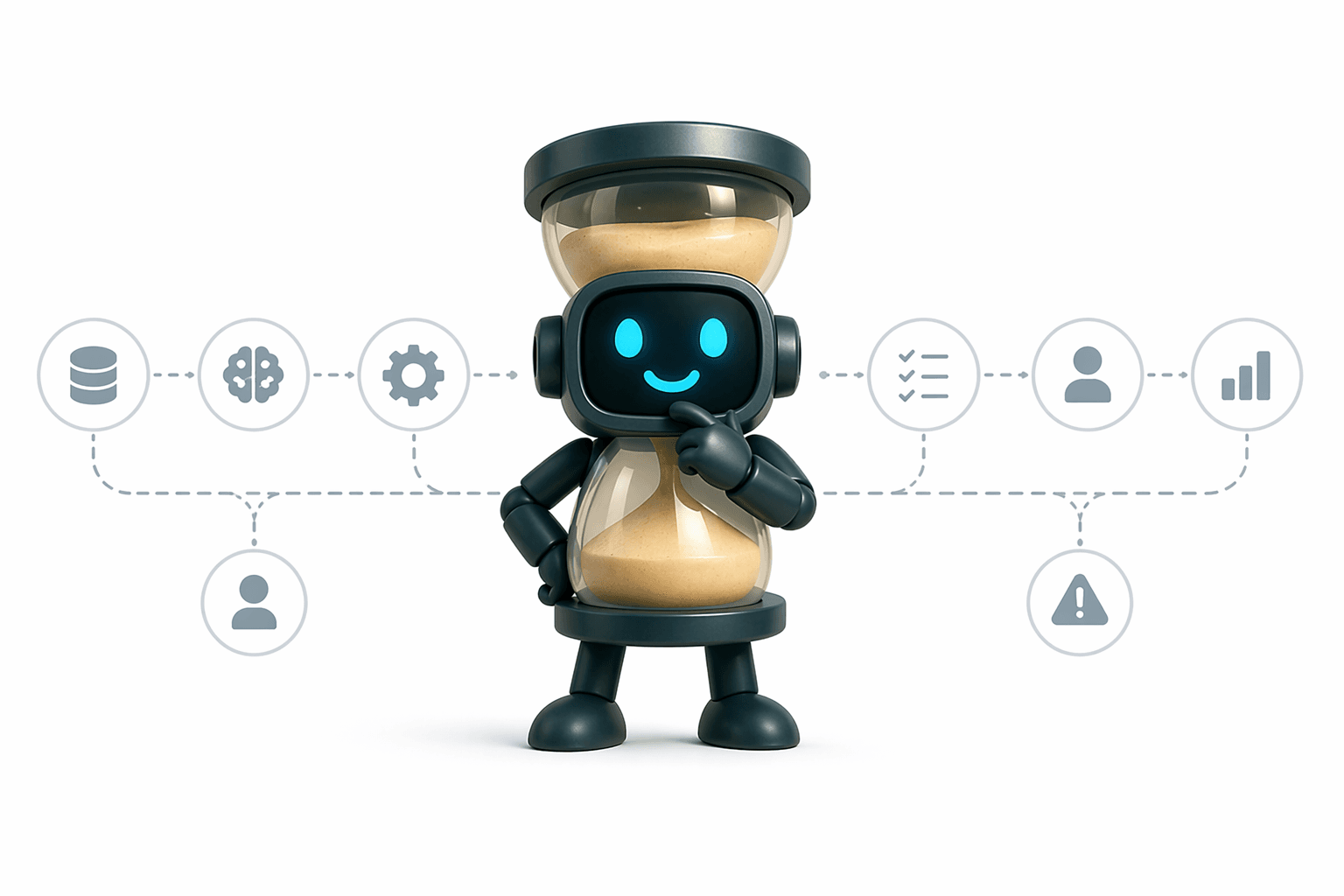
Behind Every AI-Powered System Is Manual Work Your Software Doesn’t Handle
There’s a part of every AI system no one talks about.
It’s not in the demo. It’s not in the dashboard. It doesn’t show up in the metrics people like to share.
But it’s there. Quietly holding everything together.
Manual work.
Even in companies that consider themselves highly automated, there are always gaps. Small decisions, corrections, checks, exceptions. Work that doesn’t fit neatly into the system. Work the software simply doesn’t handle.
And the problem is not that this work exists. The problem is pretending it doesn’t.
The hidden layer of manual work in AI systems K.B Consultancy insight
AI systems are designed to handle patterns. Repetitive inputs, predictable flows, structured data.
Real business operations don’t look like that.
There are always edge cases. Incomplete information. Situations where context matters more than rules. A customer request that doesn’t match any predefined category. A deal that doesn’t follow the standard process.
So what happens?
Someone steps in.
They adjust the data. They override a decision. They reroute a workflow manually. It takes a few minutes, maybe less. It feels insignificant.
But multiply that across a team, across weeks, across the entire operation. That hidden layer becomes a real part of how the business runs.
At K.B Consultancy, this is often the first thing that surfaces when we look at systems closely. Not the automation itself, but everything happening around it to keep it functional.
Why software never fully replaces operational complexity K.B Consultancy perspective
There’s an assumption that better tools will eventually eliminate manual work.
In practice, that rarely happens.
Software is built around defined logic. It needs clear inputs, clear rules, clear outputs. The moment something falls outside that structure, it either breaks or requires human intervention.
And most businesses operate in that grey area more than they realize.
Think about onboarding a new client. On paper, it’s a fixed process. In reality, every client brings slight variations. Missing documents, unusual requests, internal dependencies that shift timelines.
You can automate parts of it. Data collection, reminders, task creation. But there will always be moments where someone needs to interpret, decide, or adjust.
The mistake is trying to eliminate those moments entirely instead of designing for them.
Where AI automation breaks without acknowledging manual work K.B Consultancy approach
When manual work is ignored, systems become fragile.
They look efficient from the outside, but internally, people are constantly fixing things to keep them running. Over time, this creates a disconnect. Leadership sees automation working. Teams experience something very different.
That’s where trust starts to drop.
People stop relying on the system fully. They create backups. Side processes. Personal ways of handling exceptions. Now you have two systems running in parallel. The official one and the one people actually use.
At that point, adding more automation doesn’t help. It usually makes things worse.
What works better is making the manual layer visible. Understanding where it happens, why it happens, and whether it should exist at all.
Sometimes it should. Not everything needs to be automated. Some decisions are better left to people. The key is being intentional about it.
That’s a big part of how K.B Consultancy approaches system design. Not by forcing full automation, but by deciding where automation adds value and where human input remains necessary.
Designing systems that account for human input K.B Consultancy observation
Strong systems don’t try to remove humans from the process. They position them correctly within it.
That means defining clear points where human input is expected. Not as a fallback, but as part of the design.
For example, instead of letting exceptions break a workflow, you create a structured step where exceptions are reviewed. Instead of forcing AI to handle every decision, you define thresholds where a person steps in.
This changes how the system feels.
It becomes more stable. More predictable. People know when they are needed and why. The system supports them instead of constantly requiring hidden fixes.
It also makes automation more effective. Because now it operates within boundaries that actually reflect how the business works.
The reality behind scalable AI systems K.B Consultancy conclusion
Every scalable AI system has manual work behind it.
Not because the technology is limited, but because businesses are not perfectly structured environments. There will always be variation, and variation requires judgment.
The companies that scale successfully are not the ones that eliminate manual work entirely. They are the ones that understand it, shape it, and place it where it makes sense.
That’s the difference between a system that looks automated and a system that actually works.
And it usually starts by asking a simple question.
Where are people still stepping in, and why?
6 April 2026