AI Tools Are Everywhere, But Business Process Automation Still Fails in Practice
There is no shortage of AI tools right now. Every week there is something new that promises faster work, fewer manual steps, better decisions. Most companies have already tried a few. Some have tried dozens.
And still, when you look at day to day operations, not much has actually changed.
Tasks are still repeated manually. Information still gets lost between systems. Teams still rely on workarounds that no one officially acknowledges.
So the question is not whether AI tools work. They clearly do. The real question is why business process automation keeps falling short once it leaves the demo environment.
Why AI & Automation Tools Fail Without Process Clarity at K.B Consultancy
The problem usually starts before any tool is introduced.
Most businesses do not have a clear view of their own processes. They have an idea of how things should work, but that is not the same as how things actually happen across the team.
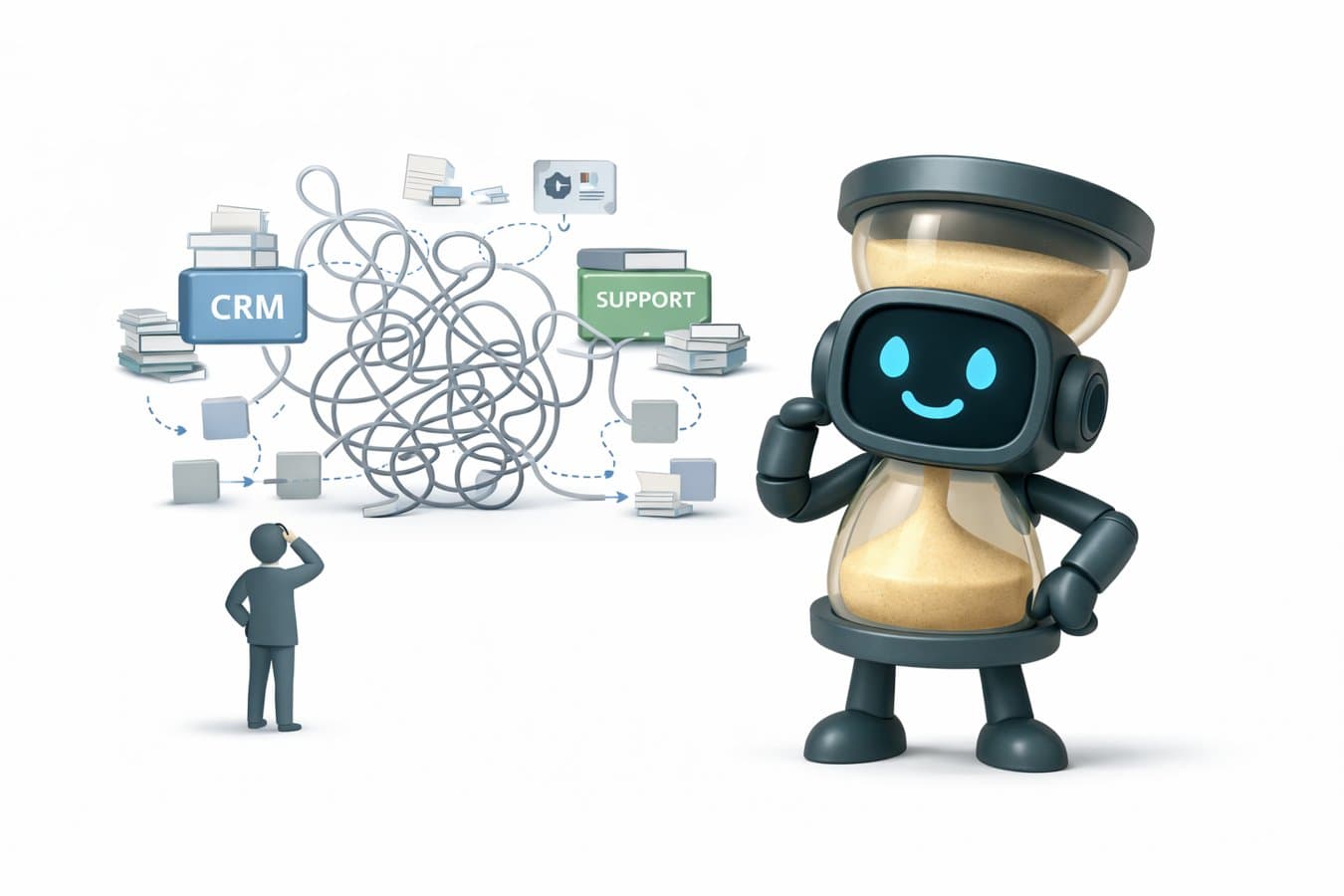
Someone in sales logs information one way. Operations adjusts it later. Support adds notes somewhere else. Over time, the process becomes fragmented, but it still functions just enough to keep things moving.
Then AI gets added on top.
Instead of fixing the fragmentation, it connects to it. Now the automation depends on inconsistent inputs, unclear ownership, and steps that are skipped under pressure.
It is not surprising that things break.
At K.B Consultancy, automation is rarely the starting point. The first step is understanding where the process is already unstable. Because once you automate it, you are not improving it, you are scaling the inconsistency.
The Real Reason Business Process Automation Breaks in Growing Companies
Growth makes this worse.
In smaller teams, people compensate for broken processes without thinking about it. They communicate informally. They fix issues on the fly. It is messy, but it works.
As the company grows, that flexibility turns into confusion.
More people means more interpretations of the same process. More tools means more disconnected data. At that point, automation starts to look like the solution.
But automation depends on consistency. And consistency is exactly what is missing.
This is where many companies get stuck. They invest in tools expecting structure to follow. In reality, structure has to come first.
Business consulting at this stage is not about strategy decks or high level advice. It is about sitting inside the operation and identifying where the process breaks under real conditions.
Those weak points are what determine whether automation will hold or fail.
AI Implementation That Survives Real Team Behavior
A common mistake is designing automation for ideal usage.
Everything assumes that data is entered correctly, that steps are followed in order, that nothing gets delayed. It looks efficient because it removes friction on paper.
But real teams do not work like that.
Deadlines shift. Inputs are incomplete. People prioritize speed over accuracy when needed. Any system that cannot handle that reality will be ignored or bypassed.
This is why many AI implementations quietly lose adoption after a few weeks.
At K.B Consultancy, workflows are built with imperfect behavior in mind. Not as an exception, but as a baseline.
That changes how systems are designed.
Instead of forcing strict sequences, there is room for recovery. If data is missing, the system flags it without blocking everything. If a step is skipped, it can be revisited without breaking the flow.
These small adjustments make the difference between a system that looks good and one that actually gets used.
Connecting Systems Through Software Development Instead of Adding More Tools
Another issue is tool overload.
Companies keep adding platforms, each solving a specific problem. CRM, support tools, internal trackers, reporting dashboards. Individually, they work. Together, they create friction.
Automation is often introduced as another layer on top of this stack.
That rarely solves the core issue.
The real problem is not the lack of tools, but the lack of connection between them.
This is where software development and integration become critical. Not in the sense of building something complex, but in making existing systems communicate properly.
When data flows cleanly between tools, many manual tasks disappear without heavy automation.
At K.B Consultancy, this is often a turning point. Instead of automating every step, the focus shifts to connecting the right ones. The result is usually simpler and more reliable.
What Actually Makes Business Process Automation Work
There is a noticeable shift happening. Companies are no longer impressed by automation that looks advanced. They want something that holds up under pressure.
That changes the criteria for success.
It is not about how much you automate. It is about whether the system reduces friction in real situations.
That only happens when the process is clear, the behavior is understood, and the system is designed around both.
AI tools are not the problem. The expectation that they will fix unclear operations is.
Once that is understood, automation starts to make sense again. Not as a quick fix, but as a layer on top of something that already works.
And that is usually where things start to improve in a way that actually lasts.
3 April 2026